Part of the project IMMENSIVA →
IMMENSIVA EXPO | 4–9 NOVEMBER 2026
Official opening: 4 November · 18:30
Public project previews: 5–9 November
Daily sessions: 16:00 · 18:00 · 20:00
Free admission · Advance booking required
Places are limited, and advance reservation is essential.
IMMENSIVA DAYS | 10–13 NOVEMBER
Talks · University Visits · Professional Encounters
Celebrating its seventh edition, IMMENSIVA FESTIVAL brings together artistic residencies, immersive exhibitions and professional encounters, showcasing 13 international XR projects through two exhibition periods in November 2026 and February 2027, following months of artistic research, mentorship and collaborative production.
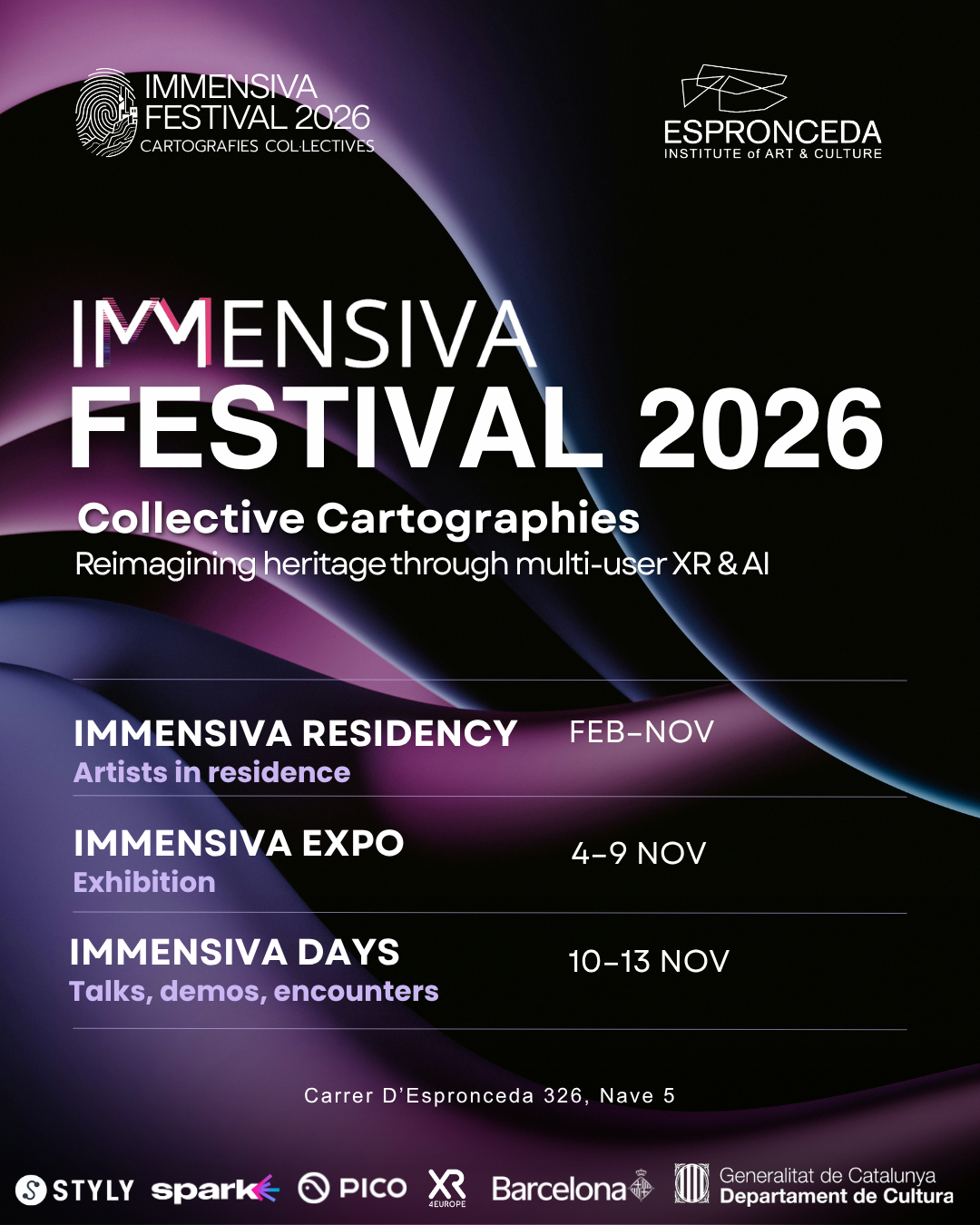
ESPRONCEDA – Institute of Art & Culture announces the seventh edition of IMMENSIVA FESTIVAL, taking place from 4 to 13 November 2026 in Barcelona, with an additional exhibition scheduled for February 2027 as part of the same artistic residency programme. Under the curatorial theme Collective Cartographies this year’s edition brings together 13 international artistic projects exploring how immersive technologies can transform our relationship with cultural heritage, memory, territory, identity and shared experience.
Building on six previous editions dedicated to artistic experimentation and emerging technologies, IMMENSIVA FESTIVAL continues to strengthen its position as an international platform for artistic research, technological innovation and interdisciplinary collaboration. The November festival will showcase eight immersive projects at ESPRONCEDA, developed through months of artistic research, mentorship and collaborative production. Following the official opening on 4 November, audiences will have the opportunity to experience these projects through free, pre-booked project preview sessions from 5 to 9 November.
Five additional international projects will undertake an in-person residency at ESPRONCEDA in February 2027, culminating in a second public exhibition. Both presentations form part of IMMENSIVA 2026, Collective Cartographies, extending the programme’s artistic reach and creating further opportunities for international exchange and visibility. Through virtual and mixed reality, spatial computing, interactive environments and immersive storytelling, participating artists invite audiences to discover new ways of experiencing and interpreting the world.
What happens when maps no longer represent only geographical territories, but also memories, emotions, identities and collective experiences? Collective Cartographies, approaches immersive art as a means of exploring the relationships between people, places and the stories that shape our understanding of the world.
From the reconstruction of historical expeditions and underwater archaeological heritage to speculative ecological futures, digital bodies and participatory rituals, the selected projects propose alternative ways of navigating both physical and virtual environments. Rather than treating technology as an end in itself, the festival explores its potential as a medium for cultural expression, collaboration and meaningful human connection. The programme brings together international artists, creative technologists, researchers and interdisciplinary teams whose practices cross the boundaries between contemporary art, cultural heritage, performance, science, design and digital innovation.
From 4 to 13 November 2026, ESPRONCEDA – Institute of Art & Culture in Barcelona will host the first exhibition period of IMMENSIVA 2026, showcasing eight international artistic projects that explore diverse approaches to immersive art, digital storytelling and emerging technologies.
Relats de la Terra explores the cultural landscape of Valencia through its folkloric and mythological heritage, revealing how traditional legends reflect the historical, social and spiritual contexts in which they emerged. Combining expertise in music, interactive systems and XR design, Alayna Hughes and Lien Tran investigate the relationship between folklore, collective identity and the communities and territories that have shaped these narratives over time. Rather than presenting myths as isolated stories, the project examines how they preserve shared memories, beliefs and cultural traditions, offering insights into the ways communities understand and interpret their surroundings. Through immersive and interactive artistic experimentation, Relats de la Terra invites audiences to rediscover Valencia’s cultural heritage, connecting historical research with contemporary technologies to create new ways of experiencing, interpreting and transmitting the stories embedded in a particular place.
Imaginary Lines is a mixed-reality adventure in which participants become active members of the French Geodesic Mission in the Royal Audiencia of Quito, working alongside French and Spanish scientists and local collaborators who set out to determine the shape of the Earth at the Middle of the World. Set between 1736 and 1743, the experience invites participants to use eighteenth-century scientific instruments reimagined as interactive tools to measure the Earth, trace triangles between mountains and gaze at the stars. As the expedition crosses challenging terrain, it encounters extreme weather, technical difficulties and unexpected events that threaten its progress. Moving between fully immersive virtual environments and the physical world enhanced by 3D elements, participants must explore, experiment and collaborate to overcome these challenges. Imaginary Lines brings science and heritage to life through a multiplayer journey that combines the precision of scientific observation with the excitement, curiosity and wonder of discovery.
Feu Bleu is a free-roaming VR experience that explores how human relationships are shaped by technology. When students at an all-girls school become fascinated by prediction markets, speculating on the worst possible outcomes begins as a game — until those outcomes become disturbingly probable. Inspired by a true story, the project unfolds in a tense neo-noir setting, combining immersive storytelling with a feminist perspective and evoking the atmosphere of Black Mirror, Thirteen (2003) and The Virgin Suicides (1999). The project brings together creative producer and immersive experience designer Raphaëlle Brissette and screenwriter, journalist and interdisciplinary researcher Victoria Emanuelle. Their collaborative practice connects immersive technologies with historical research, archives, ethnography and socially engaged storytelling, with particular attention to women’s experiences and perspectives often overlooked in dominant historical narratives.
Totems of Hope is a participatory spatial neuroaesthetic experience exploring generosity, empathy and human connection through immersive art.Created by Simeone Scaramozzino, with development by Martel Barthélemy, the project combines XR, neurotechnology, EEG-informed biofeedback, tactile interaction and neuroadaptive sound.Participants are invited into a multisensory journey structured around symbolic rituals of reflection, exchange and collective care. Physical scenography and digital environments work together to create encounters in which technology becomes a means of exploring attention, emotional awareness and interpersonal relationships.Rather than focusing on technological spectacle, Totems of Hope asks how immersive experiences might encourage meaningful connections between individuals and strengthen a sense of shared presence.
Lord Lyrical is an immersive, music-driven VR art experience that transforms sound and frequency into the foundations of a shared virtual world. Conceived for ten simultaneous participants, the experience transports audiences into a fantastical environment where each person is assigned a distinct musical frequency, influencing their perspective and visual experience. Alongside the group appears Lord Lyrical, an additional presence guiding a choreographed sequence in which music, movement and visual effects unfold in synchronisation. Blending hip-hop, immersive storytelling and collective virtual presence, the project explores the relationship between musical composition, digital worldbuilding and shared perception.
Ancient Future Underwater brings together underwater cultural heritage, digital preservation and immersive artistic creation. Developed by reality capture specialist Yuma Ito and internationally recognised XR artist Aimi Sekiguchi, the project combines photogrammetry, 3D Gaussian Splatting and virtual painting inspired by Japan’s ancient Jōmon pottery. Drawing on connections between underwater archaeological heritage in Spain and Japanese cultural traditions, the artists investigate how immersive technologies can transform historical objects and environments into shared spaces for exploration and creativity.The experience invites audiences to move beyond conventional representations of archaeology, discovering new emotional and artistic relationships with cultural memory and the natural world.
Modern Fossils is a multi-user VR installation that invites audiences to participate in an archaeological expedition set on a post-human Earth. Instead of recovering ancient monuments, participants discover everyday objects and places selected by people living in Barcelona today. Each recovered artefact reveals a recorded personal testimony, offering insight into the memories, emotions and meanings associated with ordinary possessions and familiar locations. As visitors collectively uncover these fragments, the experience creates an alternative portrait of Barcelona through the intimate stories of its inhabitants. Combining documentary storytelling, interactive exploration and speculative archaeology, the project investigates how collective memory might be preserved and interpreted by future generations.
O is an immersive extended reality stage experience in which performers and spectators share a hybrid performance space where physical reality, mixed reality and virtual worlds coexist in real time.Created by Barcelona-based artist Ferran Gordillo, the experience explores how we construct our perception of reality and what happens when the technologies we use to observe the world begin to transform it. Through science, philosophy, imagination and spirituality, the investigation of a meteorite of unknown origin gradually becomes an exploration of the observer’s own consciousness. At a time when technology can intervene in, overlay and transform what we perceive as real, O questions which aspects of our experience belong to the external world and which are shaped by the person observing it. Through a device that alters their perception, spectators become part of an unstable, constantly transforming reality.O invites audiences on an immersive journey into a space where the boundaries between reality, consciousness and imagination become increasingly indistinguishable.
Following the official opening on 4 November, ESPRONCEDA invites audiences to discover the eight international XR art projects through a series of public project previews from 5 to 9 November 2026. Designed as an immersive journey through all eight installations, each 90-minute session offers visitors the opportunity to experience the projects developed through IMMENSIVA’s international artistic residency programme. With one participant per headset, the previews offer an opportunity to engage directly with the immersive artworks and discover the diverse artistic perspectives presented under this year’s curatorial theme, Collective Cartographies.
From cultural heritage and collective memory to interactive storytelling, music, ecological reflection and alternative realities, the programme demonstrates the creative potential of immersive technologies as a medium for contemporary artistic expression. To ensure an engaging visitor experience, each session is limited to 10 participants.
Official exhibition opening: Wednesday, 4 November 2026 · 18:30
Public project previews: 5–9 November 2026
Daily Sessions: 16:00 · 18:00 · 20:00
Duration: 90 minutes per session
Capacity: 10 participants per session
The second exhibition period will introduce five additional international projects during February 2027, extending the exploration of collective cartographies through cultural history, environmental awareness, speculative futures and digital heritage.
When Brooklyn Was Queer transports audiences to Brooklyn in 1894, when vaudeville culture was flourishing and Coney Island was emerging as a major centre of entertainment. At the heart of the narrative is Marion Hines, a fearless male impersonator determined to build an independent life and establish her place on stage.Through her story, the immersive experience explores performance, identity, chosen family and forbidden desire, bringing audiences close to a world of queer cultural history that has often remained underrepresented.Developed by New Canvas, the project uses immersive storytelling to revisit historical narratives through intimate human experiences and perspectives.
The Burner Boys (working title) is an immersive VR project investigating the human and environmental consequences of the global electronic waste crisis. Tracing the lifecycle of consumer electronics from production and everyday use to disposal, the experience draws attention to the impact of electronic waste on communities in Ghana, including locations such as Agbogbloshie. Through immersive storytelling, the project seeks to connect personal consumption habits with their wider social and environmental consequences. By making distant realities more immediate, The Burner Boys explores VR’s potential to encourage empathy, critical reflection and awareness of global inequalities.
Katábasis is an interactive immersive documentary that takes audiences beneath the streets of New York, exploring the city’s hidden underground labyrinth and the human stories that inhabit its depths. Drawing on the ancient Greek myth of katabasis — a descent into the underworld — the experience gives voice to those who live, work or seek refuge in these often-invisible spaces. Their intersecting stories reveal a complex territory beneath the familiar urban landscape, inviting audiences to reconsider the city’s overlooked realities.Created by Marseille-based visual and digital artist Ugo Arsac, whose practice explores mythology, anthropology and urban exploration, Katábasis combines immersive technologies with poetic documentary storytelling. The project had its world premiere at the 2026 Cannes Immersive Competition, where it received the Grand Prize, reinforcing Arsac’s international recognition in immersive art.
Digital Monuments is an artistic dialogue between Swedish artists Love Antell and Lena Trapp, whose distinct visual practices converge through video projections to explore how monuments, cultural memory and collective identities are being reimagined in the digital age.The project examines not only the digitisation of existing monuments and their historical narratives, but also the possibilities of creating a new generation of digital monuments. Moving beyond traditional notions of permanence, physical presence and fixed meaning, it proposes monuments as evolving forms of representation, capable of transformation and reinterpretation over time.Bringing together Antell’s exploration of cultural heritage and digital transformation with Trapp’s multidisciplinary practice spanning sculpture, installation and moving image, Digital Monuments considers both official histories and overlooked narratives that shape our understanding of place.At the intersection of memory, technology and representation, the project invites audiences to reflect on how societies preserve, reinterpret and construct collective narratives, questioning what monuments might become in an increasingly digital world.
Echoes of the Deep: A Collective Dive into Possible Futures is an asymmetrical, multi-user XR experience exploring the ecological future of the Baltic Sea. Two participants enter separate virtual underwater environments, each representing a contrasting future: one marked by ecological degradation, abandoned fishing equipment and environmental hazards, and another shaped by restoration and regenerative practices. Meanwhile, additional participants collaborate from outside the headsets through a projected interface, acting as a remote safety vessel with access to environmental information and navigational data.Progress depends on communication and cooperation between immersed and non-immersed participants, transforming the exhibition space into a shared environment for collective decision-making. Developed by Germany-based NeoNature Studio, the project combines ecological storytelling, speculative futures and collaborative interaction to explore how human choices shape the environments we inhabit.
IMMENSIVA FESTIVAL is more than an exhibition programme. It forms part of ESPRONCEDA’s ongoing commitment to supporting artistic research, experimentation and collaboration across the creative and technological sectors.
Through its residency and mentorship framework, IMMENSIVA brings together artists, creative technologists and interdisciplinary professionals to develop innovative approaches to immersive creation. The festival encourages dialogue between contemporary artistic practices and emerging technologies, while exploring opportunities for collaboration with cultural institutions, universities, museums and international XR stakeholders.
This approach positions immersive technologies not only as tools for artistic production, but also as instruments for education, cultural interpretation and new forms of public engagement.
From 10 to 13 November 2026, as part of IMMENSIVA FESTIVAL 2026, IMMENSIVA DAYS will bring together artists, researchers, universities, cultural professionals and XR industry representatives at ESPRONCEDA in Barcelona for four days dedicated to artistic innovation, knowledge exchange and interdisciplinary collaboration. The programme will feature talks, workshops, project demonstrations and professional encounters, offering opportunities to explore emerging practices in immersive storytelling, extended reality (XR) and digital artistic production.
A key highlight will be the evaluation of the participating projects by an expert jury, which will select the winning project of the 2026 edition, recognising artistic excellence, technological innovation and creative experimentation. IMMENSIVA DAYS will also welcome university groups, students and emerging professionals through organised visits and educational activities, fostering dialogue between the next generation of creators and the international immersive arts community. Participation in university visits and professional activities will require prior registration. Further details about the programme, speakers and registration will be announced through the festival’s official communication channels.
IMMENSIVA is ESPRONCEDA – Institute of Art & Culture’s flagship programme dedicated to immersive art and emerging technologies. Through artistic residencies, exhibitions and international collaborations, it supports experimentation with XR, AI and interactive media. Celebrating its seventh edition, IMMENSIVA 2026 – Collective Cartographies brings together international artists exploring cultural heritage, collective memory and shared immersive experiences, fostering artistic innovation, interdisciplinary collaboration and cultural impact. More information: www.immensiva.com
PRESS CONTACT
Maria Rubies I maria.rubies@espronceda.net I +34 607 639 552
ESPRONCEDA – Institute of Art & Culture
www.espronceda.net
Please subscribe to newsletter to get updates from us.
Free invitations to our openings, open calls for artists and our programme, before anyone else.