Presented by: ESPRONCEDA – Institute of Art & Culture
Venue: Carrer d’Espronceda 326, Nau 5, 08027 Barcelona
Opening: Thursday, October 1, 2026 · 7:00 PM – 9:30 PM
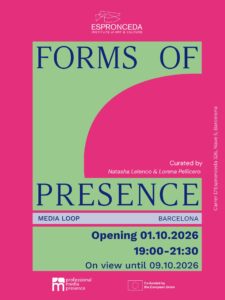
ESPRONCEDA – Institute of Art & Culture announces Forms of Presence: Media Loop, opening on October 1st, 2026, on view through October 9th at Carrer d’Espronceda 326, Nau 5. The exhibition marks the culmination of Professional Media Presence (PMP), gathering the results of the project’s full trajectory (including online seminars, workshop weeks and artist residencies) and opens simultaneously across seven venues in six countries: Finland (Turku and Lapland), Malta, Croatia, Italy, Slovakia and Barcelona.
Forms of Presence: Media Loop brings together eight artists exploring how identity is never built in solitude but constituted in encounter with others — an encounter that today is increasingly mediated by data, screens and devices. The exhibition takes its name from the word MEDIA itself, where the letters ID appear contained in reverse, as if reflected in a mirror: identity emerges from within the medium, but is returned to us transformed into representation. Across video, ceramics, installation, painting and generative AI, the artists trace how media both connect us to the other and produce the very images through which we recognize or differentiate ourselves — drawing on inherited archives, religious and digital rituals, intimate memory, and the architectures of contemporary devices.
Structured as a circuit, the show gives its own paradox a name: media multiply our possibilities for reaching the other without ever guaranteeing that this access becomes true encounter, widening the distance between connection and relation even as it promises to close it. Curated by Natasha Lelenco & Lorena Pellicero.
LIST OF WORKS
Elisa de la Torre
Cartografías de la Intimidad Digital
Medium: digital heat maps, painting on canvas
Elisa de la Torre approaches identity through the intimate, tactile relationship we maintain daily with our devices. The mobile screen registers patterns of use that the artist transforms into heat maps, making visible an identity captured through repetition — the body leaving a digital inscription that she translates into organic stains. The action concentrates on the minimal gesture of touching and swiping, yet that gesture unfolds within possibilities already organized by the device itself; its repetitions and pathways generate loops of behaviour that, accumulated, draw out a shape, a landscape — an abstract cartography of everyday contact with technology. In this final stage, the artist reverses the process once more: data becomes matter again, translated into painting on canvas, closing a circuit between body and algorithm.
Miguel Ripoll
Grand Tour
Medium: public domain archive, computational processes, manual intervention
Miguel Ripoll‘s work leads us toward the historical construction of otherness. His series Grand Tour recovers the name of a practice that would go on to shape the genealogy of modern tourism — one linked to eighteenth-century Enlightenment culture, in which young aristocrats travelled through France and Italy on a journey that was, in a sense, initiatory, but that also implied a specific position from which to observe and consume other territories and cultures. Drawing on public domain archives, his computational processes retrieve materials produced by earlier systems of representation, which the artist recomposes and manually intervenes upon once again. In these works, technology processes inherited ways of looking and reveals that the image of the other is always a construction — in the sense proposed by Victor I. Stoichita, “difference exists, but alterity is constructed”: representation as the result of historical systems that determine who looks, how they look, and whom they turn into the object of that gaze. Formally, the works retain a palimpsest-like condition, where layers of archive, algorithmic process and manual intervention overlap.
David Feroce
Los nuevos pecados / Hagiografía del Glitch
Medium: ceramic, moving image projection
David Feroce recovers religious and ritual repertoires and transposes them, in a direct and ironic register, onto behaviours typical of digital culture. If we speak of inherited ways of seeing, we cannot overlook older symbolic repertoires: philosopher Byung-Chul Han has pointed to the almost liturgical dimension of certain digital practices, where followers and influencers configure contemporary rituals of belonging — the like as a gesture of adhesion, sharing as communion, the whole as liturgical practice. In Los nuevos pecados, four ceramic apples revisit the symbol of sin to point to the capture of attention, excessive consumption and the erosion of connection; the face of social networks is personified through a mask, granting an anthropomorphic, archaizing presence to an otherwise abstract structure. In Hagiografía del Glitch, a ceramic hedgehog figure is accompanied by its own moving projection: the glitch becomes an interruption of flow, a small event that turns technological failure into an apparition charged with spiritual resonance.
Elvira Martos
Medium: collage, mixed media
Elvira Martos‘s work relates identity to the computational theory of mind, understood as a system of information processing. The piece addresses the traces that experience leaves on the body and memory, built from a collage of dreams that emerged during a therapeutic process, gathering seemingly disconnected elements into a single amalgamated image — almost a system of codes. The figures appear to recognize and duplicate one another, as though they were relatives, or perhaps different versions or moments of a single identity, while the threatening landscape turns the setting itself into an active agent of interpretation. This instability extends to the other elements too: strange or hybrid creatures introduce forms whose identity never quite settles. The installation extends this logic through layers of representation — Cem overlapping Cordon Bleu, concealing part of the image and altering its reading, while Puppy Jr. is placed in dialogue with the whole.
Natasha Lelenco
URthe1
Medium: digital imagery
In Natasha Lelenco‘s work, identity reveals itself as a serial construction of shared codes. The series URthe1 draws on the repertoires of digital imagery, where repetition and perceptual “dopaminization” play into the economy of attention. The portraits present themselves as deliberately artificial constructions: the faces stem from a morphology close to the round arch, lending them the quality of a tunnel or a hypnotic interface, while anatomical inadequacy is used as a technique of anthropomorphization — the figures display their own artifice, adopting a frontality that oscillates between avatar and icon, like minimal variations within a single system. The floral motifs that compose the backgrounds draw on the mechanisms of pareidolia, forms that approximate a face and multiply its presence. The series finds its meaning in multiplicity and circulation, echoing the incessant flow of images and models that shapes new collective imaginaries.
Marla Jacarilla
Liminal State
Medium: video art, generative artificial intelligence
One of these shared contemporary imaginaries runs through Marla Jacarilla‘s video piece. Liminal State takes the form of a diary organized across different moments of 2025, where intimate experience, collective events and readings layer onto a succession of liminal spaces reconstructed through generative artificial intelligence. In one entry, Jacarilla introduces her reading of Mark Fisher’s Capitalist Realism: drawing on Fredric Jameson, Fisher notes how an incessant rhythm of change can coexist with an extreme standardization — when everything is subjected to the perpetual change of the media image, “nothing can ever really change again.” The liminal spaces can be read, from there, as images of that impasse: recognizable places suspended between an inherited familiarity and a future that never quite arrives. The piece thus produces two distinct registers — a collective, inherited yet artificial territory, and a writing that reinscribes within it a concrete subjectivity — with the subject remaining off-screen, made present only through the written account.
Edo García
#UNBOXING
Medium: installation
Edo García‘s installation unfolds from the contrast between two registers of intimacy: on one side, a domestic space tied to shelter and a certain vulnerability; on the other, the exposed intimacy of YouTube users who turn their homes into stages for displaying weapons to an anonymous audience. Violence, fear, consumption and exhibition enter into a single circuit — the weapon becomes an object of desire, violence and fear become viral content, and the domestic space oscillates between refuge and shop window. #UNBOXING transfers this tension onto the viewer’s own body, who must lie down on an unmade bed to access the images, setting a spectacularized intimacy against another, embodied and vulnerable one. The relation to the other is established only through looking — intimacy is received, consumed, but without reciprocity, so proximity produces little more than the illusion of encounter.
Lorena Ruiz Pellicero
You Blink Your Eyes, We Do the Rest
Medium: installation, interactive device
Lorena Ruiz Pellicero‘s installation locates mediation within the very act of looking. You Blink Your Eyes, We Do the Rest proposes a device in which smart contact lenses turn vision into a technological interface: to see, one must subscribe, accept terms, surrender data. If encountering others is a fundamental part of how the self is constructed, the piece ironizes on the conditions that devices impose on that encounter, pushing the promise of “assisted vision” to its absurd extreme. As the artist states, “vision becomes a service, blinking becomes an interface, and intimacy becomes an exploitable resource.”
About PMP
Forms of Presence: Media Loop is presented within the framework of Professional Media Presence (PMP), co-funded by the Creative Europe programme of the European Union, and marks the culmination of the project — bringing together the results of its full trajectory. The exhibition opens simultaneously in seven venues across six countries: Finland (Turku and Lapland), Malta, Croatia, Italy, Slovakia and Barcelona.
PMP responds to the growing influence of media in shaping artistic identity, addressing challenges such as misinformation, precarity and the constantly shifting digital tools artists are expected to navigate. By equipping artists with digital skills and fostering cross-border collaboration, the project strengthens cultural resilience and diversity across the continent.
Between 2023 and 2025, PMP organised five online seminars, workshop weeks and artist residencies for collaborative creation and skill-building, connecting artists from six EU countries — Finland, Croatia, Italy, Malta, Slovakia and Spain. In total, 113 artists across different artistic fields and career stages took part, with a strong focus on inclusion: the project prioritises artists facing barriers such as disability, health issues, economic hardship, social or political challenges, geographic isolation or cultural difference.
The project is structured around five core themes: Media & Art, exploring how media shapes artistic expression and cultural narratives; Online Media & Digital Storytelling, focused on creating and sharing digital stories effectively; Social Media & Media Readership, addressing audience engagement and responsible media use; Future Media, examining emerging technologies such as artificial intelligence and virtual reality and their ethical applications in art; and Media & Professional Identity, guiding artists in building an authentic online presence.
The consortium behind PMP brings together Turku University of Applied Sciences (coordinator) and Lapland University of Applied Sciences (Finland), Youth for Equality (Slovakia), ESPRONCEDA – Institute of Art & Culture (Spain), Perypezye Urbane (Italy), Culture Hub Croatia and Prisms (Malta).
Practical information
Free admission.
Exhibition dates: October 1–9, 2026
Visiting hours: 17:00–19:00, upon prior registration by email to info@espronceda.net
Opening: October 1st, 2026, 19:00–21:30
Location: ESPRONCEDA – Institute of Art & Culture, Carrer d’Espronceda 326, Nau 5, 08027 Barcelona.
Press contact
maria.rubies@espronceda.net
+34 607 639 552